

Bikinis, Martinis, and Daddy Poo: Jamie Brickhouse Comes to Puerto Vallarta
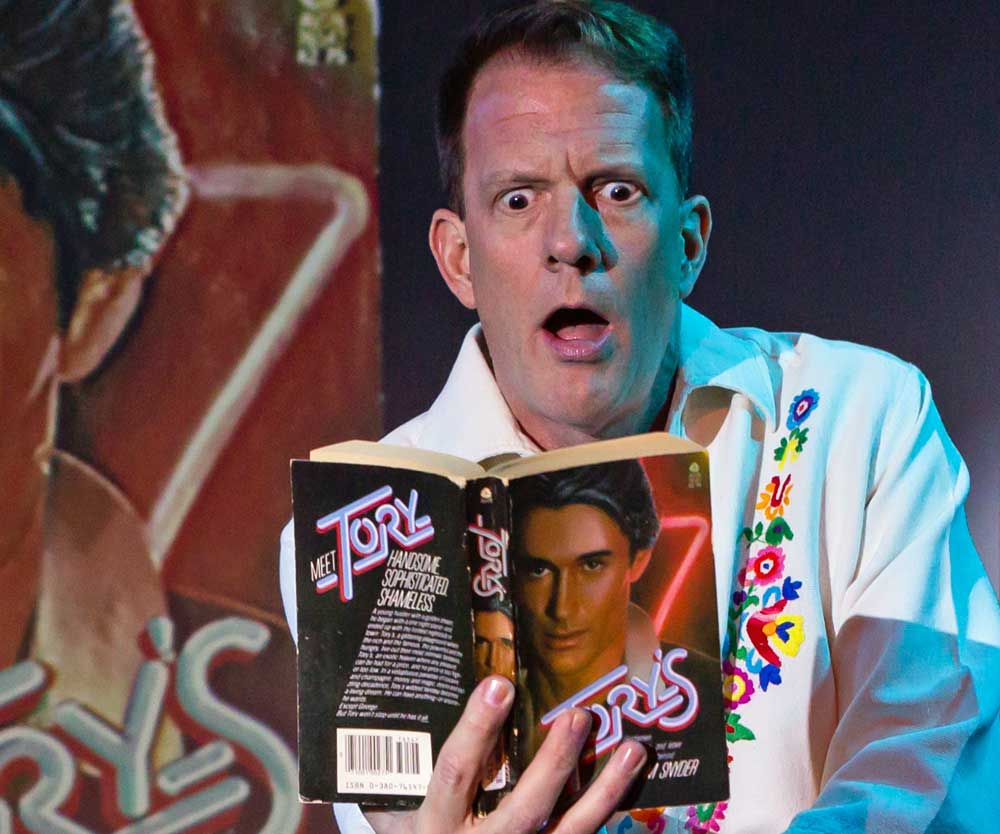
Storyteller, writer, and stage performer Jamie Brickhouse is bringing his acclaimed solo show I Favor My Daddy: A Tale of Two Sissies to Puerto Vallarta for four performances at ART VallARTa. The shows take place at 7:00 PM on Friday and Saturday nights, March 13, 14, 20, and 21.
For audiences in Puerto Vallarta, Brickhouse’s visit offers something special: an internationally recognized storyteller performing one of his most personal—and entertaining—works in an intimate theater setting. Known for his sharp wit, vivid characters, and fearless honesty, Brickhouse has built a reputation for turning the messy truths of family life into stories that are as hilarious as they are moving.
A Story About Fathers, Sons, and What We Inherit
I Favor My Daddy: A Tale of Two Sissies is the follow-up to Brickhouse’s earlier solo show based on his book Dangerous When Wet: A Memoir of Booze, Sex, and My Mother. That earlier work centered on his formidable Texas mother, Mama Jean, and Brickhouse’s own struggles with addiction, sexuality, and growing up under the force of her personality.
The new show turns its attention to his father, Earl—known affectionately as Daddy Poo. But moving the spotlight didn’t mean his mother disappeared from the story.
“Even though Mama Jean’s huge personality doesn’t get the spotlight in this show, she still casts a long shadow,” Brickhouse says. “I could hear her in my head saying, ‘See, I told you he’s a drunk just like you and he’s gay just like you!’”
As he began exploring his father’s story, Brickhouse realized something else: Earl was just as big a character as Mama Jean.
“What I discovered is that Daddy Poo had as big a personality as she did,” he says. “It’s a wonder the two of them survived.”
Their marriage was intense, often volatile, and filled with sharp humor. At one point Brickhouse asked his father if he had ever seen the famous stage drama Who’s Afraid of Virginia Woolf?, known for its brutally combative married couple.
“Seen it?” Earl replied. “I lived it!”
Yet beneath the clashes and the theatrics was genuine love—something Brickhouse says became clearer as he looked back on their relationship while writing the show.

“You Favor Your Daddy”
The title of the show comes from a phrase Brickhouse heard often growing up in Texas: “You favor your daddy.” In the American South, it simply means a child resembles their father.
But as Brickhouse grew older, those words began to carry a deeper meaning.
“You favor your daddy is a Southern way of saying you look like your father,” he explains. “But what I realized in the years leading up to writing the show was just how much I am a fully realized version of my father.”
The similarities went far beyond appearances. As Brickhouse examined his life and his father’s, he began to see shared instincts, habits, and vulnerabilities.
“I don’t just resemble him in looks,” he says. “I inherited so many of his marvelous and destructive traits. Every child eventually has to reckon with who their parent was and what of their parent exists in them. It’s how we make sense of who we are.”
That reckoning—funny, uncomfortable, and deeply human—forms the emotional core of the show.
A Complicated Kind of Acceptance
One of the most fascinating dynamics in I Favor My Daddy is the relationship between Brickhouse and his father. Earl was a Catholic conservative from Texas who nonetheless accepted his son’s homosexuality—something not every gay man of Brickhouse’s generation experienced.
But that acceptance came with layers of contradiction.
“Daddy Poo accepted my homosexuality,” Brickhouse says. “But he never accepted his own—that’s my true feeling.”
Faith was also central to Earl’s identity. The Catholic Church shaped his worldview and daily routine. When Brickhouse got sober, his father wondered whether that transformation might lead him back to the church.
“I told him that since I’ve been sober, I go to meetings almost every day the way you go to Mass every morning,” Brickhouse recalls. “Those meetings are my church.”
His father never raised the subject again.
Moments like these—funny, revealing, and emotionally complex—are the building blocks of Brickhouse’s storytelling.
Bikinis, Martinis, and Texas in the 1970s
Two running motifs in the show—bikinis and martinis—capture the contradictions of Earl’s life and personality.
The martinis represent the drinking culture that surrounded both father and son. For years Brickhouse resisted his mother’s claims that Earl was an alcoholic. At the time, Brickhouse enjoyed drinking himself and assumed his mother was exaggerating.
That perspective changed after he got sober.
“When I got sober I realized she was probably right,” he says.
The bikini, however, is a detail that feels almost too perfect to be real.
“My father had an orange bikini he loved,” Brickhouse says. “And my mother absolutely forbade him to wear it.”
This was conservative Texas in the early 1970s, where certain social rules went unspoken but were widely understood. While no one explicitly said only gay men wore bikinis, the implication hung in the air.
Looking back, Brickhouse believes that swimsuit may have been a small, quiet expression of something his father never openly acknowledged.


Comedy as a Path to Truth
Even as the show wrestles with questions of addiction, denial, and identity, humor is never far away.
Brickhouse’s instinct for comedy comes naturally. In fact, he credits his father for giving him the lens through which he sees the world.
“I inherited my sense of humor from Daddy Poo,” he says. “He saw the absurdity in life.”
Sometimes humor acts as a defense mechanism, he admits. But it also serves another purpose: revealing truths that might otherwise remain hidden.
The observation echoes the famous insight of Sigmund Freud, who wrote that jokes often expose underlying realities.
“In this show I start with humor to reveal difficult subjects,” Brickhouse says. “Then I go for the heart.”
A Show That Works Anywhere
I Favor My Daddy debuted at the New York International Fringe Festival, where it played to sold-out audiences. The production was stripped down to the essentials.
“I performed it in a Martha Graham dance studio with a velvet curtain behind me,” Brickhouse recalls. “It was bare bones.”
Later productions added visuals and technical elements, but the Fringe performances taught him something important.
“I realized I don’t need any of that,” he says. “This show is really about storytelling. All I need is a stage and an audience.”
That simplicity makes the show particularly well suited to intimate venues like ART VallARTa, where audiences can experience the story up close.
Telling the Story After His Father’s Death
One of the most personal aspects of the show is the realization that Brickhouse likely would never have performed it while his father was still alive.
Before Earl died, Brickhouse had already begun asking himself difficult questions about his father—about his drinking, his possible sexuality, and the complicated marriage he shared with Mama Jean.
“I was already thinking about writing about him,” Brickhouse says.
But his father’s death changed everything.
“When he died, it liberated me to write freely about him,” he says. “More importantly, it allowed me to really dig deep into those questions.”
The show ultimately became not only a portrait of Earl but also a way for Brickhouse to understand himself.
Brickhouse sometimes imagines how his father might react if he could sit in the audience today.
The verdict, he suspects, would be both amused and slightly indignant.
“Daddy Poo loved a party, loved theater, and loved being the center of attention,” Brickhouse says.
So while he might object to some of the conclusions his son draws, Brickhouse believes Earl would still enjoy the spectacle.
“He’d probably say, ‘Now that’s not true—but damn you sure can tell a story!’” Brickhouse laughs. “Then he’d raise his martini and yell, ‘I love it!’”
Four Nights in Puerto Vallarta
Puerto Vallarta audiences will have four opportunities to experience I Favor My Daddy: A Tale of Two Sissies when Jamie Brickhouse performs at ART VallARTa at 7:00 PM on Friday and Saturday evenings, March 13, 14, 20, and 21.
For anyone who appreciates sharp storytelling, unforgettable characters, and humor that reveals deeper truths, the show promises an evening that is both entertaining and unexpectedly moving.
As Brickhouse proves on stage, the most powerful stories are often the ones that begin with family—and end with discovering who we really are.